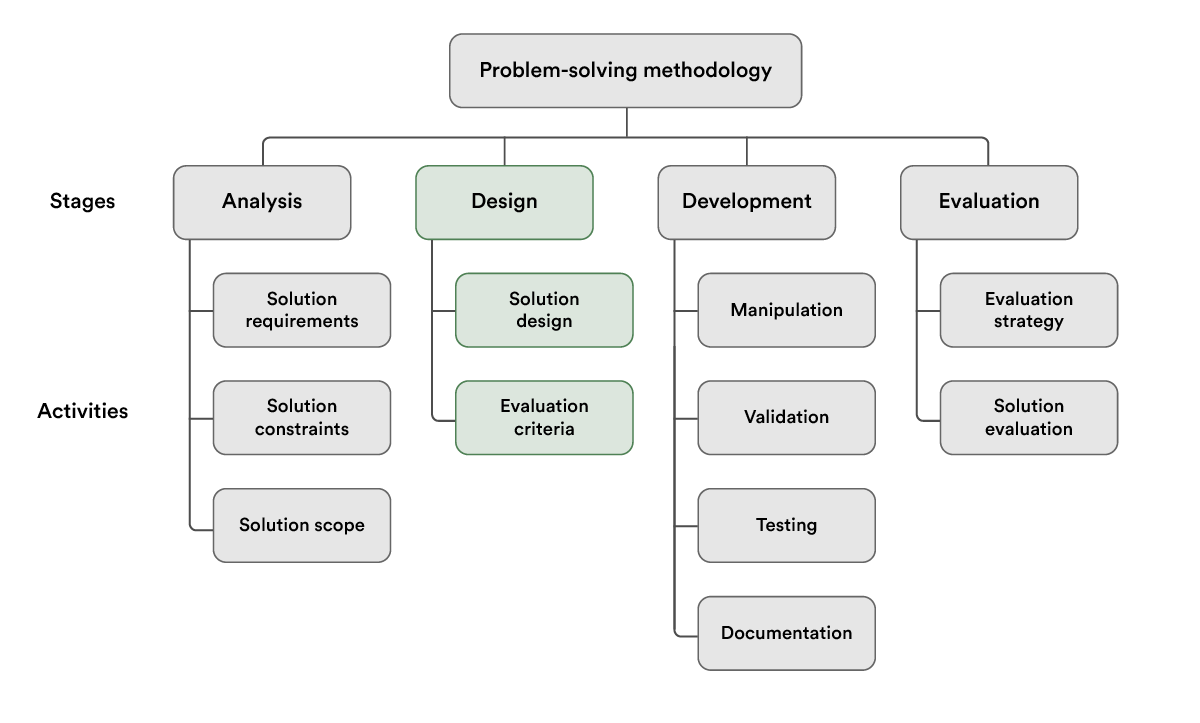
The design stage is just like how it sounds. This is the stage where you start designing your solution, which involves developing an evaluation criteria.
Solution design
The solution design is how your solution is going to fulfill your requirements described in the analysis stage.
Typical methods of doing this are:
- Wireframes
- Mockups
- Pseudocode
- Object descriptions
- Flowcharts
The design, however, is more than just how you’re handling data; it should also include how your solution displays it.
To begin with design, you may need to provide evidence of developing your ideas. Using tools to like mind maps, mood boards, kanban boards and more will all help you brainstorm your ideas.
Evaluation criteria
How will you determine whether your solution is successful or not? Do designs match the requirements outlined in the analysis stage?
Your evaluation criteria should consider:
- Efficiency of your solution, a measure of how much time, cost and effort is required to perform your solution.
- Processing time
- Operational costs
- Resources, such as storage
- Effectiveness of your solution, a measure of how well your solution achieves its intentions.
- Usability
- Accuracy
- Accessibility
- Security
- Integrity
- Reliability
Writing evaluation criteria
- Choose a requirement to meet.
- List possible methods and/or sub-requirements. The larger, broader requirement should be broken down into how your ideal design should include.
- After designing, give your designs a rating for each sub-requirement.
Although not difficult to write, a good evaluation criteria should be:
- Specific and unambiguous - it should not be broad, but rather focused on a specific problem/requirement, allowing better evaluating.
- Measurable - whether you have fulfilled a requirement or not should be easily measurable and clear.
- Direct & outcome-oriented - it should be focused on the results and consequences of your solution.
Example evaluation criteria
Requirement: users should be able to comment on a post Criteria:
- Bottom of the page should have an easily usable textbox.
- The comment section should be labelled and clearly distinct from the rest of the page.
- The user should be able to format their comment.
- The owner of the post should be able to report and take down any unwanted comments.
- Spamming, and other risks should be considered.